

#SocialMedia @WeedConnection
:: FYi FB/iG Terminated WC Accts Again ::
:: No Just Cause FB iS Run By Sociopaths ::
:: They iNvested iN Criminal Competition ::
:: See Fed RiCO Lawsuit @ SCOTUS @ RR ::. . . .
:: Join Us For A Hollyweed Sesh ::
:: Subscribe, Follow, Like, Add, Share ::
@WeedCONNECTiON

SOCIAL:
twitter.com/weedconnection
instagram.com/weedconnection
facebook.com/weedconnection
myspace.com/weedconnection420
youtube.com/weedconnection420
BUSINESS:
weedconnection.com
weedconnection.com/advertise
CREATOR:
@RussellRope @ russellrope.com/blog
#Support Your #OG(s)
#LinkUP @WeedConnection

@WeedConnection .com
#FreeTheOG
#FreeTheWeed
Fund WC++
Read RR True Story
Connect | ADVERTISE | Work | Submit
Subscribe | Follow | Share | Like | Support


#iNTERNATiONAL #DiRECTORY @WeedConnection
New directory with maps etc. in development....
LiMiTed oFFeR: dOuBLe DuRAtiON oF NeW LiSTiNGs (wHiLe sTiLL iN DeV mOde)
oR 10% DiScOuNt :: Select You Plan @ [click here]
Ask about our current promotion, which is a free listing with purchase of any other service @WeedConnection. Recently started rebuilding our global database and added a new/temp delivery section to our directory. Send us an email to submit any current information. Click here for listing and advertising information. The directory is a huge project that requires maintenance. We still have big plans for future development and production. Join(t) the team as a regional manager, college intern, street team member, or click here for a list of other open positions. Support, subscribe, follow, share, like, and mention growing cannabis business @WeedConnection

#NORML #News @WeedConnection
Analysis: Marijuana-Related Tax Revenue Surpasses That of Alcohol
Washington, DC: Legal marijuana states generated more revenue from retail cannabis sales than they did from alcohol sales, according to data provided by the Institute on Taxation and Economic Policy (ITEP).
According to ITEP's analysis, legal states in 2021 collected an estimated 20 percent more in taxes from retail marijuana sales than from the sale of alcohol products. In California, cannabis excise taxes brought in more than double the revenue of alcohol-related taxes. In Colorado, cannabis-tax revenues totaled seven times those of alcohol.
"[I]t is remarkable that in the span of just a few years, the narrow ‘sin taxes' that states created to apply to cannabis purchases have managed to surpass the comparable taxes that have long applied to alcohol," authors of the analysis wrote.
According to a separate analysis provided earlier this year by the Marijuana Policy Project, tax revenues derived from the licensed retail sale of state-legal, adult-use cannabis products grew by more than 30 percent between 2020 and 2021, totaling over $3.7 billion last year.
Study: Cannabis Consumers Report Improvements in Insomnia
Ontario, Canada: The use of cannabis products is associated with perceived improvements in insomnia in patients suffering from either anxiety or depression, according to data published in the journal BMC Psychiatry.
A team of Canadian researchers assessed the effectiveness of cannabis in managing insomnia in a cohort of 677 subjects. Study participants suffered from either anxiety, depression, or from both conditions simultaneously. Subjects self-administered cannabis products at home and reported symptom changes in real time on a mobile software application. Investigators analyzed reports from over 8,400 cannabis-use sessions recorded over a three-year period.
Consistent with prior reports, subjects from all three groups reported significant benefits from cannabis. Participants perceived CBD-dominant products to be less effective than others.
"This naturalistic investigation of cannabis use for insomnia suggests that individuals with depression, anxiety, and comorbid depression and anxiety perceive benefits from using cannabis for sleep," authors concluded. "In addition, compared to other cannabis strains, CBD-dominant products may be less helpful for sleep, specifically in individuals with depression. The current study highlights the need for placebo-controlled trials investigating the efficacy and safety of cannabinoids for sleep in individuals with mood and anxiety disorders."
Full text of the study, "An investigation of cannabis use for insomnia in depression and anxiety in a naturalistic sample," appears in BMC Psychiatry.
Uruguay: No Sustained Changes in Young People's Cannabis Use Patterns Following Legalization
New York, NY: The adoption of nationwide regulations governing the retail sale of cannabis to adults is not associated with sustained increases in young people's cannabis consumption, according to data published in the journal Addiction.
An international team of researchers from Chile, the United States, and Uruguay assessed cannabis use trends in Uruguay among those ages 12 to 21 following legalization.
Uruguay initially approved legislation legalizing the use of cannabis by adults in 2013, although retail sales in licensed pharmacies did not begin until 2017. Under the law, cannabis sales are restricted to those age 18 or older who register with the state. Commercially available cannabis products may only be produced by state-licensed entities and sold at specially licensed pharmacies. THC levels are capped by regulators and government price controls are imposed upon flower. Limited home cultivation is allowed in private households.
Consistent with prior studies, researchers reported no significant changes in cannabis use patterns among either adolescents or young adults. Among those under the age of 18, marijuana use fell following legalization. Among those ages 18 to 21, cannabis use initially rose, but then decreased.
Authors concluded, "The legalization of recreational cannabis in Uruguay was not associated with overall increases in either past-year/past-month cannabis use or with multi-year changes in any risky and frequent cannabis use among young people."
Numerous North American studies have similarly failed to identify any significant upticks in cannabis use by young people following the adoption of adult-use legalization in either US states or in Canada.
Full text of the study, "Does recreational cannabis legalization change cannabis use patterns? Evidence from secondary school students in Uruguay," appears in Addiction.
Study: Liberalized Marijuana Laws Not Associated with Clinically Relevant Changes in Birth Outcomes
West Lafayette, IN: Changes in the marijuana's legal status under state law are not associated with increases in adverse clinical birth outcomes, according to data published in the journal Population Research and Policy Review.
Researchers affiliated with Purdue University assessed the relationship between the liberalization of state-level cannabis possession laws and two birth outcomes that are key indicators of child health: birthweight and gestational age.
Authors reported a trend toward reductions in average birthweight and gestational age for some groups of women following the relaxation of state-level marijuana penalties. However, they acknowledged that these changes were not linked to any "increases in clinically meaningful birth indicators associated with adverse child health."
They concluded: "Our findings indicate that cannabis policy liberalization may be contributing to lower average birthweights and reduced average gestational age, but not in a manner that has increased low birthweight (<2500 g) infants or preterm (<37 weeks) births. These results indicate that while cannabis policies have not led to increases in adverse clinical birth outcomes overall, these trends are worth monitoring to ensure that increases in clinically relevant child health outcomes do not emerge as the nationwide trend toward liberalized cannabis policy persists. Additionally, while we may not be witnessing substantial changes in adverse birth outcomes, policymakers should be attentive to the opportunities to strengthen child health by considering policies that may minimize consumption, particularly heavier forms of consumption, by prospective parents." The findings are similar to those reported in a 2021 study which identified either "modest or no adverse effects of marijuana liberalization policies on the array of perinatal outcomes considered." Studies assessing the potential impacts of in utero cannabis exposure on perinatal health are inconsistent. While some observational studies have identified a link between exposure and low birth weight and/or an increased risk of preterm birth, other studies have failed to substantiate these outcomes after adjusting for confounding factors, such as tobacco smoking. Full text of the study, "The liberalization of cannabis possession laws and birth outcomes: A state-level fixed effects analysis, 2003-2019, appears inPopulation Research and Policy Review.
Kentucky: Lawmakers Advance Measure Facilitating State-Sponsored Cannabis Research
Frankfort, KY: State lawmakers have approved legislation, House Bill 604, establishing a cannabis-specific medical research center at the University of Kentucky.
Provisions in the measure define the mission of the new center as follows: "Conduct and fund research, [including clinical trials,] related to cannabis and cannabis derivatives, including pharmaceutical development and the efficacies of cannabis and cannabis derivatives for the treatment of certain medical conditions and diseases; Conduct and fund research related to the health effects, including the potential risks or side effects, of the use of cannabis and cannabis derivatives; (c) Conduct and fund research related to the efficacy and potential health effects of various cannabis delivery methods, including but not limited to vaporizing, ingestibles, topical applications, and combustion; Review current and future cannabis research literature, clinical studies, and clinical trials."
Democratic Gov. Andy Beshear said that the establishment of the center should not slow down legislative efforts to legalize medical cannabis access for a broad range of patients who could benefit from it. "I think we need to move toward legalization, even as the center gets up and going," Gov. Beshear said last week. "There's a lot of research out there already. It's okay that we want to be a part of future research. But it shouldn't be used as an excuse to stall that momentum."
Legislation to legalize and regulate medical cannabis in the state passed the House of Representatives this spring, but Senate leadership refused to take up the issue. In response to the Senate's inaction, Gov. Beshear has indicated that he may use his office's executive powers to amend the state's marijuana policies. However, he has not yet provided specifics as to what these changes might entail.
Several states - including California, Colorado, Florida, and Pennsylvania - have similarly established state-sponsored institutions to conduct clinical trials and other research specific to the safety and efficacy of cannabis.
Text of HB 604 is available online.

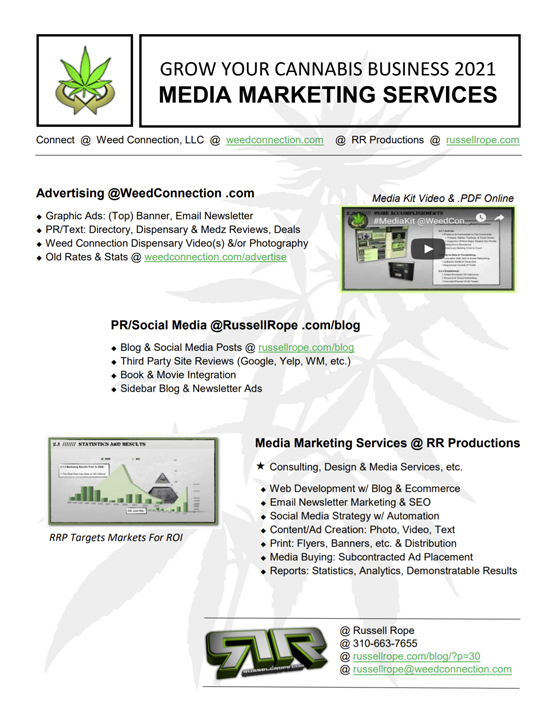
#Cannabis #Media #MarketinG @WeedConnection
Click Here For The
Cannabis Media Marketing PDF
~~~~~~~~~~~~~~~~~~~~~~~~~
Grow Your Cannabis Business
~~~~~~~~~~~~~~~~~~~~~~~~~~~
Connect | ADVERTISE | Work | Submit
Subscribe | Follow | Share | Like | Support
Cannabis Media Marketing PDF
~~~~~~~~~~~~~~~~~~~~~~~~~
Grow Your Cannabis Business
~~~~~~~~~~~~~~~~~~~~~~~~~~~
Connect | ADVERTISE | Work | Submit
Subscribe | Follow | Share | Like | Support
#FreeTheWeed @WeedConnection
~~~~~~~~~~~~~~~~~~~~~~~~~~~
#FreeTheOG #Fundraiser @ RR
~~~~~~~~~~~~~~~~~~~~~~~~~~~
Media Marketing Services,
& New Deals
@ RRP
~~~~~~~~~~~~~~~~~~~~~~~~~~~
#FreeTheOG #Fundraiser @ RR
~~~~~~~~~~~~~~~~~~~~~~~~~~~
Media Marketing Services,
& New Deals
@ RRP
#FollowFriday @RussellRope #OG @WeedConnection
* New Show NQ @TheTrueOGReport *
* READ & Click & READ & Click *
:: Creator @ WC @ RR Productions ::
:: Follow @RussellRope For Updates ::

:: Join The Revolution ::
:: Read & Take Action ::
:: True OG Stories @ RR ::
:: SUPREME #LegalTrillOG ::
----------------------------------
:: Media Marketing Services @ RRP ::

:: Connect | ADVERTISE | Work | Submit ::
:: Subscribe | Follow | Share | Like | Support ::
:: #FreeTheWeed @WeedConnection ::
#NORML #News @WeedConnection
Meta-Analysis: Youth Cannabis Exposure Not Associated with Changes in Brain Morphology
Canberra, Australia: Cannabis exposure is not associated with significant changes in brain morphology in young adults, according to a meta-analysis of neuroimaging studies published in the journal Cannabis and Cannabinoid Research.
A team of Australian researchers reviewed sixteen studies in order to assess whether cannabis exposure is associated with changes in brain volume. The review samples included 830 participants with a mean age of 22.5 years old. Of these, 386 were marijuana users (with cannabis use onset at 15-19 years) and 444 were controls.
Researchers identified no significant differences between youth cannabis users and controls in global and regional brain volumes.
"This meta-analysis of structural MRI findings specific to youth regular cannabis users suggests no volume alterations, and no effect of age and cannabis use level on group differences in volumetry," authors concluded. "Important areas for future work include measuring and embracing the role of cannabis potency, pubertal stage, and personal (and parental) education, to identify which brain maturation stage is most vulnerable to cannabis-related brain and mental health/wellbeing. New knowledge will be necessary to provide clear recommendations for preventive interventions targeting youth at risk and update addiction theory with novel mechanistic insights into neurodevelopment."
Full text of the study, "Brain anatomical alterations in young cannabis users: A meta-analysis of structural neuroimaging studies," appears in Cannabis and Cannabinoid Research.
Study: Marijuana Legalization Laws Are Not Associated with Lax Attitudes Toward Drugged Driving
Research Triangle Park, NC: Adults in states where the use of cannabis is legal are less likely than those in non-legal states to report having driven under the influence of cannabis, according to data published in the journal Preventive Medicine Reports.
Investigators affiliated with the research institute RTI International assessed drugged driving attitudes and behaviors in a nationwide cohort of 1,249 current marijuana consumers.
The study's authors reported: "Current cannabis users in recreational and medical only cannabis states were significantly less likely to report driving within three hours of getting high in the past 30 days, compared to current users living in states without legal cannabis. The one exception was frequent cannabis users who lived in medical cannabis states. Their risk of DUIC [driving under the influence of cannabis] did not differ significantly from frequent users living in states without legal cannabis."
Commenting on the study's findings, NORML's Deputy Director Paul Armentano said: "These findings ought to reassure those who feared that legalization might inadvertently be associated with relaxed attitudes toward driving under the influence. These conclusions show that this has not been the case and that, in fact, consumers residing in legal marijuana states are less likely to engage in this behavior than are those residing in states where cannabis possession remains criminalized."
Authors theorized that consumers in legal marijuana states may have greater exposure to messaging highlighting the risks and legal ramifications associated with drugged driving.
"Although all states should educate its citizens about the potential dangers of using cannabis and driving, this analysis suggests that states without legal cannabis are particularly in need of DUIC prevention efforts," they concluded. "States should consider mass media campaigns as a method of reaching all cannabis users, including more frequent users, with information about the dangers of DUIC. Medical states may consider targeting frequent users by disseminating information about DUIC through medical dispensaries. Further research is warranted, particularly given the constantly evolving nature of cannabis legalization and the noted limitations of this analysis."
The study's results are consistent with the findings of a 2021 paper which similarly determined that incidences of self-reported drugged driving behavior do not become more prevalent post-legalization. Rather, authors reported, "[M]arijuana users in states that legalized RM [recreational marijuana] self-reported driving after marijuana use less than their counterparts (who resided in states where adult-use cannabis remained illegal). They were also less likely to find such behavior [driving after ingesting cannabis] acceptable."
Numerous on-road and driving simulator studies have reported that the acute effects of THC inhalation are associated with certain changes in driving behavior, such as an increased likelihood of weaving and a decrease in a drivers' average speed. These and other changes are typically less pronounced in subjects who are more habitual cannabis consumers, but they may be exacerbated when alcohol and marijuana are ingested in combination with one another.
State-level data has failed to show any uptick in motor vehicle accidents attributable to the enactment of medical cannabis laws, while data assessing the potential impact of adult-use legalization has shown less consistent results.
Full text of the study, "Cannabis legalization and driving under the influence of cannabis in a national U.S. sample," appears in Preventive Medicine Reports.
Survey: Over Half of Canadian Patients with MS Report Consuming Cannabis
Edmonton, Canada: Most Canadians diagnosed with multiple sclerosis (MS) report using cannabis to mitigate their symptoms, according to data published in the journal Multiple Sclerosis and Related Disorders.
Researchers affiliated with the University of Alberta, Department of Medicine surveyed MS patients' frequency of cannabis use and their motivations for consuming it. Canadian officials legalized the use of medical cannabis products nearly two decades ago. Adult-use sales were legalized in 2018. An oral spray containing precise ratios of plant-derived THC and CBD (Sativex) has also been available by prescription in Canada for the treatment of MS since 2005.
Authors reported that nearly two-thirds of respondents had consumed cannabis during their lifetimes and that 52 percent identified themselves as current users. Patients most frequently reported consuming cannabis to address symptoms related to sleep (84 percent), pain (80 percent), and spasticity (69 percent). Respondents said that cannabis was "moderately to highly effective" at mitigating their symptoms. The majority of patients acknowledged learning about the therapeutic use of cannabis from "someone other than [their] healthcare provider."
Human trials indicate that the use of both whole-plant cannabis and cannabis extracts can alleviate various symptoms of the disease as well as potentially modulate its progression.
Full text of the study, "Medical cannabis use in Canadians with multiple sclerosis," appears in Multiple Sclerosis and Related Disorders.
Ohio: Retail Cannabis Sales Would Yield $374 Million in Annual Tax Revenue
Columbus, OH: The establishment of a regulated adult-use cannabis market in Ohio could yield as much as $374 million dollars in annual tax revenue, according to a newly published economic analysis.
A pair of researchers affiliated with Ohio State University estimated the amount of new tax revenue that would be raised by the passage of proposed citizen's ballot initiative. The initiative, if enacted, would impose a ten percent tax on the retail sale of cannabis products.
Researchers projected that licensed retailers could raise between $276 million and $374 million annually by year five of operations. They described their estimates as "conservative."
According to an analysis by the Marijuana Policy Project, tax revenues derived from the licensed retail sale of state-legal, adult-use cannabis products grew by more than 30 percent between 2020 and 2021, totaling over $3.7 billion last year. Adult-use sales generated the greatest amount of revenue in California ($1.3 billion), followed by Washington ($631 million), Illinois ($424 million), and Colorado ($396 million).
In January, advocates with Ohio's Coalition to Regulate Marijuana Like Alcohol turned in the requisite number of signatures from registered voters to place an adult-use legalization proposal before lawmakers. The measure allows for the possession of up to 2.5 ounces of marijuana or 15 grams of marijuana extract by those age 21 or older. Adult Ohioans could purchase marijuana at retail locations or grow up to 12 plants in a private residence (where at least two adults reside).
Lawmakers thus far have refused to take any action on the measure. If they ultimately fail to do so, advocates can elect to gather additional signatures to place the measure before voters on the November ballot.
Full text of the study, "What tax revenues should Ohioans expect if Ohio legalizes adult-use cannabis," is available online.
Texas: African Americans Disproportionately Comprise Those Arrested Statewide for Marijuana Possession
Austin, TX: African Americans comprise nearly one-third of all Texans arrested for marijuana possession offenses, despite comprising only 13 percent of the state's total population, according to an analysis of state arrest data compiled by Texas NORML.
Since 2017, just over 30 percent of those arrested for possessing cannabis in Texas were Black. By comparison, Whites comprise 41 percent of the state's population, but only 30 percent of possession arrests.
Overall, Texas police made an estimated 219,000 marijuana-related arrests between 2017 and 2021. Ninety-seven percent of those arrested were charged with possession only. Fifty-six percent of those arrested were under 25 years of age.
"Minor marijuana possession offenders, many of them young people, should not be saddled with a criminal record and the lifelong penalties and stigma associated with it," said Jax James, Executive Director of Texas NORML.
A 2020 analysis of marijuana arrest data by the American Civil Liberties Union, concluded, "Black people are 3.64 times more likely than white people to be arrested for marijuana possession, notwithstanding comparable usage rates." Authors reported, "In every single state, Black people were more likely to be arrested for marijuana possession, and in some states, Black people were up to six, eight, or almost ten times more likely to be arrested. In 31 states, racial disparities were actually larger in 2018 than they were in 2010."
Since 2017, total marijuana possession arrests have decreased in Texas year over year. However, Black people now comprise a greater percentage of those arrested than in the past.
#Advertise @WeedConnection
#SocialMedia @WeedConnection
:: FYi FB/iG Terminated WC Accts Again ::
:: No Just Cause FB iS Run By Sociopaths ::
:: They iNvested iN Criminal Competition ::
:: See Fed RiCO Lawsuit @ SCOTUS @ RR ::
:: Join Us For A Hollyweed Sesh ::
:: Subscribe, Follow, Like, Add, Share ::
:: No Just Cause FB iS Run By Sociopaths ::
:: They iNvested iN Criminal Competition ::
:: See Fed RiCO Lawsuit @ SCOTUS @ RR ::
:: Join Us For A Hollyweed Sesh ::
:: Subscribe, Follow, Like, Add, Share ::
@WeedCONNECTiON
SOCIAL:
twitter.com/weedconnection
instagram.com/weedconnection
facebook.com/weedconnection
myspace.com/weedconnection420
youtube.com/weedconnection420
BUSINESS:
weedconnection.com
weedconnection.com/advertise
CREATOR:
@RussellRope @ russellrope.com/blog
#Support Your #OG(s)
#LinkUP @WeedConnection
@WeedConnection .com
#FreeTheOG
#FreeTheWeed
Fund WC++
Read RR True Story
Connect | ADVERTISE | Work | Submit
Subscribe | Follow | Share | Like | Support
#iNTERNATiONAL #DiRECTORY @WeedConnection
New directory with maps etc. in development....
LiMiTed oFFeR: dOuBLe DuRAtiON oF NeW LiSTiNGs (wHiLe sTiLL iN DeV mOde)
oR 10% DiScOuNt :: Select You Plan @ [click here]
Ask about our current promotion, which is a free listing with purchase of any other service @WeedConnection. Recently started rebuilding our global database and added a new/temp delivery section to our directory. Send us an email to submit any current information. Click here for listing and advertising information. The directory is a huge project that requires maintenance. We still have big plans for future development and production. Join(t) the team as a regional manager, college intern, street team member, or click here for a list of other open positions. Support, subscribe, follow, share, like, and mention growing cannabis business @WeedConnection