Presidents’ Day

Share This

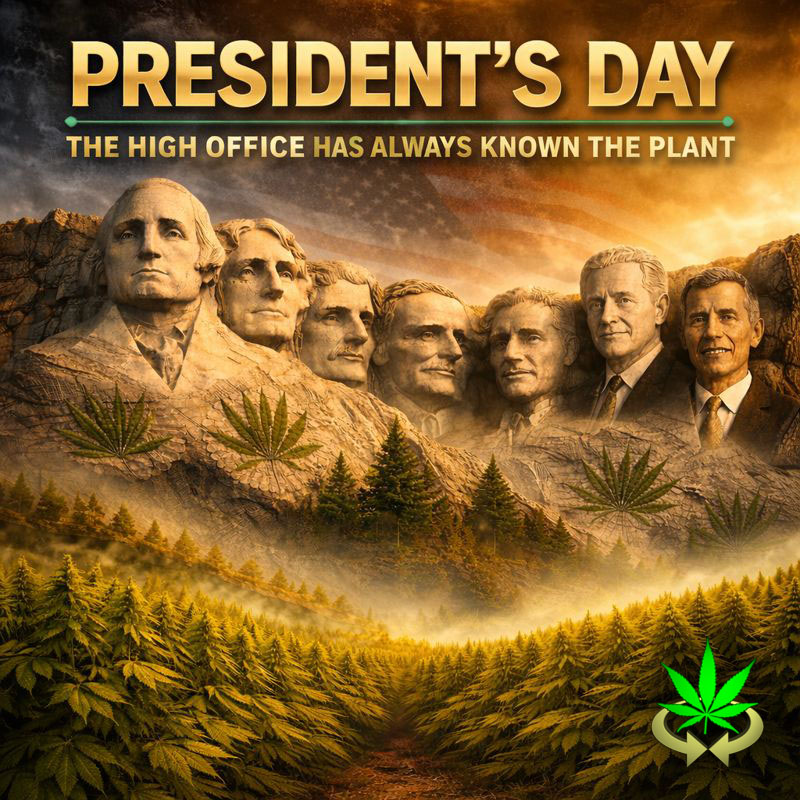
The High Office Has Always Known the Plant

February 16, 2026

Power, policy, and perspective—America’s leadership has never been as disconnected from cannabis as history is often taught.

A Presidential Reality Check

President’s Day is usually wrapped in cherry trees, marble monuments, and sanitized legends. But the real history of American leadership is far more grounded—literally. From hemp fields and paper mills to pain remedies and candid modern admissions, cannabis has moved through the lives of U.S. Presidents and Founding Fathers since the country’s beginning.

Not as rebellion.
Not as scandal.
As agriculture, medicine, curiosity, and—eventually—honest reflection.

This isn’t about glorifying use. It’s about correcting the record.
Hemp Was the Backbone Before It Was a Battleground

George Washington didn’t just tolerate hemp—he cultivated it. At Mount Vernon, Washington grew cannabis as a strategic crop for rope, sails, and textiles. His personal farm journals include notes about separating male and female plants, indicating hands-on agricultural knowledge. In Washington’s America, cannabis wasn’t political. It was practical.

Thomas Jefferson followed suit at Monticello, advocating for hemp as a domestic alternative to imported materials. Jefferson used hemp paper, promoted self-sufficiency, and lived in a time when cannabis tinctures were common in medical practice. The plant represented independence, not controversy.

James Madison and James Monroe governed during an era where hemp was embedded in infrastructure. Cannabis supported naval power, commerce, and medicine. There was no stigma—only utility. Laws criminalizing the plant wouldn’t appear for another century.

And while not a President, Benjamin Franklin belongs in this conversation. Franklin ran one of America’s earliest paper mills, using hemp to print pamphlets and books. Cannabis helped carry revolutionary ideas through ink and paper. Free speech, quite literally, rode on hemp.

Frontier America: Normalized Use, No Panic

During the 19th century, cannabis extracts were standard medicine.

Andrew Jackson, Zachary Taylor, Franklin Pierce, and Abraham Lincoln all lived in a United States where cannabis tinctures were legally prescribed for pain, anxiety, sleep, and inflammation. Patent medicines frequently contained cannabis. Hemp rope, clothing, and paper were part of daily life.

Lincoln—often mythologized into purity—grew up in a frontier culture where hemp farming was routine. There is no evidence of criminalization, moral panic, or political outrage around cannabis during his lifetime. That reaction came later, driven by fear, not fact.
The Shift: Silence, Then Cautious Honesty

By the 20th century, cannabis had been politicized. Presidents didn’t suddenly stop encountering it— they stopped talking about it.

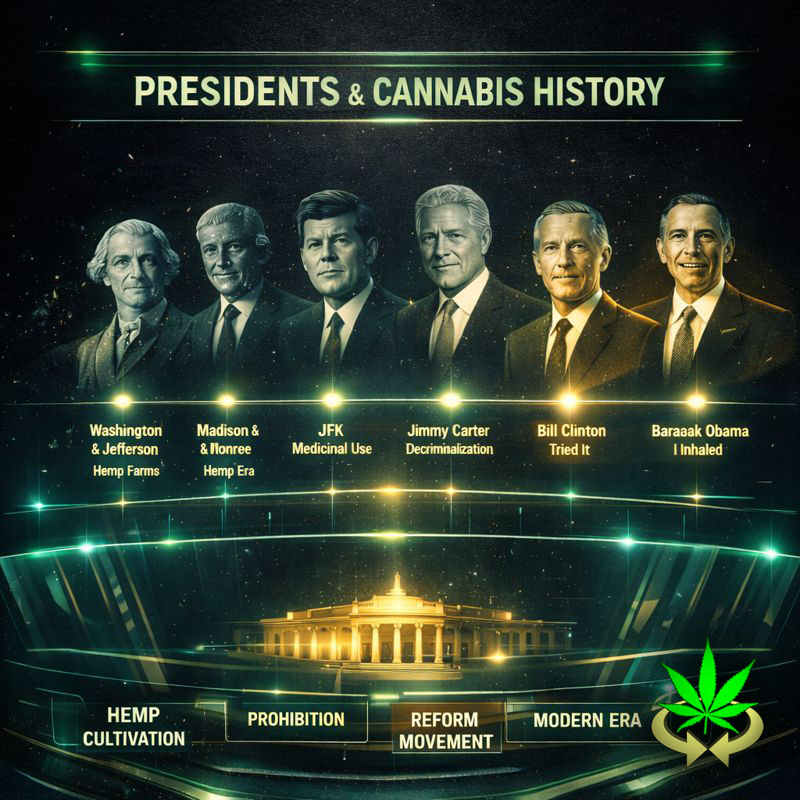
That changed with Bill Clinton, who publicly admitted experimenting with marijuana. His infamous “didn’t inhale” comment became a cultural punchline, but the admission itself mattered. It cracked a door that had been sealed shut.

George W. Bush acknowledged past marijuana use in interviews, choosing discretion over detail. The admission reflected reality without inviting political warfare—an unspoken normalization behind closed doors.

Then came Barack Obama, who spoke openly about cannabis use in his youth in both interviews and his memoirs. Obama framed it as a common experience, not a defining flaw. As President, he presided over the most significant shift toward state-level legalization in U.S. history, acknowledging that cannabis policy had failed communities and logic alike.

Vibes

Cannabis didn’t suddenly appear—it was always here. What changed was who felt safe telling the truth.

How to Observe President’s Day — Weed Connection Style

  • Respect history before repeating slogans
  • Separate hemp facts from prohibition fiction
  • Consume responsibly, intentionally, and informed
  • Support brands and policies aligned with equity and reform
  • Remember: honesty moves culture faster than denial

Cannabis didn’t weaken leadership. Silence did.

Presidents navigated war, economy, and culture while living in a nation where cannabis was once normal, then demonized, and now rediscovered. The arc isn’t about indulgence—it’s about realism.

Pulse Check

If cannabis has been part of American leadership since the beginning, what exactly are we still pretending not to know?

The plant didn’t change. The story did. And now that story is finally catching up with itself.
Interesting Facts

  • Hemp was once encouraged—and sometimes required—to be grown by American farmers
  • Cannabis medicines were sold legally in U.S. pharmacies until the early 1900s
  • Prohibition-era cannabis laws were driven more by fear and politics than science

Verified Links

Popular Hashtags

#PresidentsDay
#WeedConnection
#CannabisHistory
#HempHeritage
#HigherOffice
#CannabisCulture

“Honesty is the first chapter in the book of wisdom.” — Thomas Jefferson

“Facts are stubborn things.” — John Adams

“Progress is impossible without change.” — George Bernard Shaw

President’s Day isn’t about pretending leaders were perfect. It’s about understanding they were human—working, thinking, healing, and evolving in the same world we inherited.

Cannabis was there then.
It’s here now.
And the future looks a lot more honest 🌿🇺🇸

Valentines @WeedConnection

Valentine’s Day

Share This

Love Is in the Air… Literally

February 14

Because nothing sets the mood like good energy, good company, and good flower.

A Higher Kind of Romance

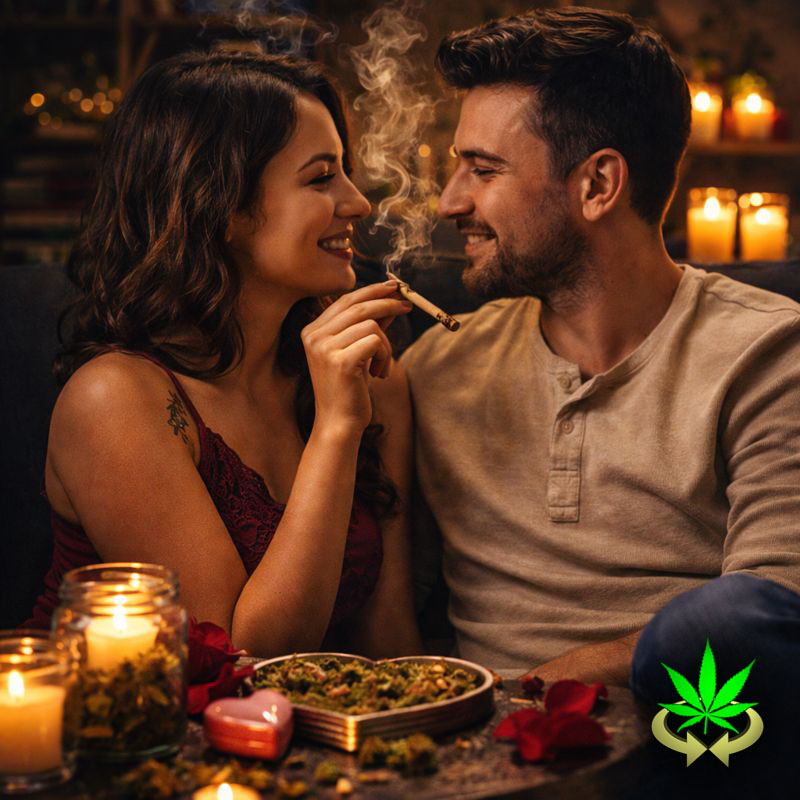
Valentine’s Day has always been about connection — not just hearts and chocolates, but presence. Cannabis fits that ritual perfectly. It slows the moment, sharpens the senses, and turns ordinary time into intentional time. Whether you’re celebrating with a partner, a situationship, or your own fine self, the plant has a way of making everything feel more… felt.

On weed, conversations linger longer. Music hits deeper. Touch is warmer. Laughter comes easier. Love doesn’t need to be loud — sometimes it just needs to be lit.

Rolling One for the Ones You Love

Cannabis has quietly become part of modern romance. It’s passed between hands instead of words, shared before dessert, or saved for the end of the night when the world finally shuts up. Unlike rushed dates and forced gestures, weed encourages patience — the kind that makes eye contact meaningful again.

And let’s be honest: a good strain can be a better wingman than flowers ever were.

Smoking together isn’t about getting faded — it’s about syncing frequencies. Matching pace. Sharing a moment that doesn’t need a caption.

Self-Love Is Still Love

Valentine’s Day isn’t only for couples. Cannabis is undefeated when it comes to solo romance.

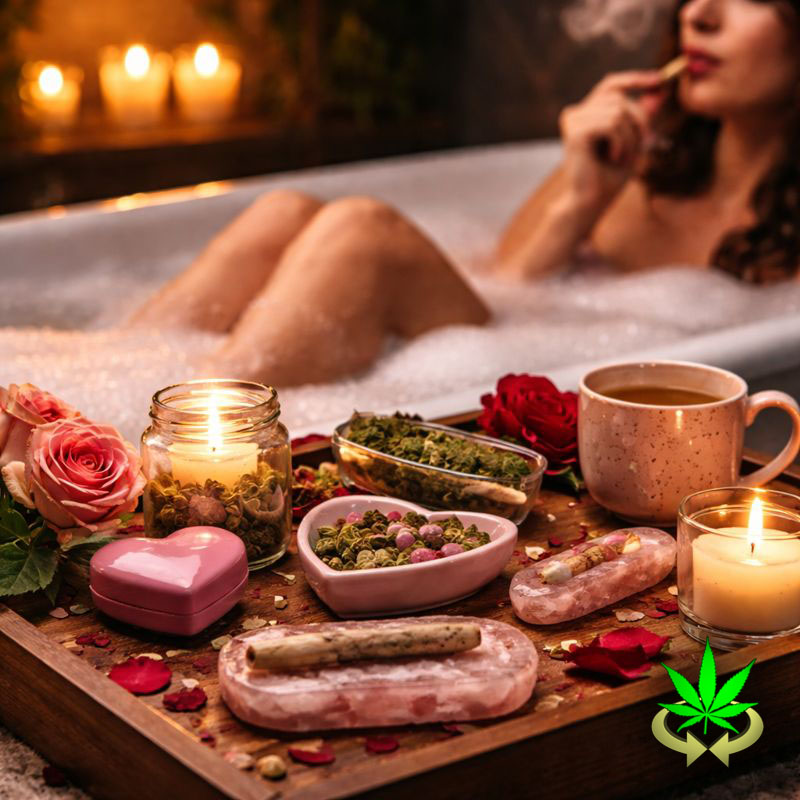
Light up. Put the phone down. Cook something indulgent. Watch something beautiful. Let your thoughts soften instead of spiral. Weed doesn’t judge, rush, or compare — it just meets you where you are.

Sometimes the most important relationship to nurture is the one you have with your own peace.

Vibes

Soft lights, slow hits, and feelings that don’t need explaining.

How to Celebrate Valentine’s Day — Weed Connection Style

  • Choose a strain that matches the mood (relaxing, euphoric, or playful)
  • Share the bowl — or enjoy it solo without guilt
  • Set the environment: music, lighting, comfort
  • Keep it intentional, not excessive
  • Let the night unfold naturally

Love doesn’t need to be extravagant. It needs to be present.

Cannabis doesn’t replace romance — it removes the noise around it. It helps people listen better, laugh easier, and stay right where they are instead of rushing to what’s next.

Pulse Check

Are you celebrating love… or actually feeling it?

Because the best Valentine’s moments aren’t planned. They’re sparked, shared, and remembered long after the smoke clears.

Interesting Facts

  • Cannabis has long been associated with relaxation and sensory enhancement
  • Many couples report deeper conversation and emotional openness when sharing weed
  • Valentine’s Day is one of the most popular nights for shared at-home experiences

Popular Hashtags

#ValentinesDay
#WeedConnection
#LoveAndFlower
#HighOnLove
#CannabisCulture
#GoodEnergy

“Where there is love there is life.” — Mahatma Gandhi

“Love recognizes no barriers.” — Maya Angelou

“The best thing to hold onto in life is each other.” — Audrey Hepburn

Whether you’re lighting up together or keeping things personal, Valentine’s Day is about connection — to someone else, to yourself, or to the moment right in front of you.

Love softly.
Smoke responsibly.
And let the vibes do the talking 💚🌹

NORML News @WeedConnection

NORML News

Share This
NORML News @WeedConnection

Weekly Stories, Studies, Surveys, Poll Results, Laws, etc.


Analysis: In Utero Cannabis Exposure Not Associated With Later Developmental Delays

Chapel Hill, NC: Infants exposed to cannabis in utero are no more likely to require emergency department care or suffer from developmental delays than non-exposed children, according to data published in the journal Academic Pediatrics.

Investigators affiliated with the University of North Carolina at Chapel Hill examined the relationship between in utero cannabis exposure and infants’ health care utilization and developmental outcomes.

“Compared to those unexposed, … children who were exposed to cannabis in utero have similar WCC [well child care] attendance and ED [emergency department] use over the first 2 years and similar developmental outcomes at 3 years,” researchers reported.

The authors acknowledged that their results were consistent with those of other studies, finding no differences in ED visits or developmental delays among cannabis-exposed and cannabis-unexposed children.

Although many studies have associated in utero cannabis exposure with low birth weight, longitudinal studies following in utero-exposed infants to adulthood have generally failed to identify “any long-term or long lasting meaningful differences” in their neurodevelopment.

Full text of the study, “Health care utilization and developmental delay among infants exposed to cannabis in utero,” appears in Academic Pediatrics.

California: Supreme Court Rules Police Can’t Search Vehicles Based on “Weed Crumbs”

Sacramento, CA: Police may neither charge a motorist with violating California’s “open container law” nor search a person’s vehicle solely upon the identification of a small quantity of marijuana “crumbs” on the floorboards, according to a ruling handed down by the state’s Supreme Court.

In a unanimous opinion, the Justices determined that the state’s “open container” law should not be applied so broadly as to pertain to situations where police find “any loose marijuana” in a motor vehicle. Rather, the court decided that the marijuana “must be of a usable quantity, in imminently usable condition, and readily accessible to an occupant” to constitute a violation of the state’s “open container” law.

The Court further determined that a police officer’s identification of “weed crumbs” does not provide probable cause for a warrantless vehicle search. They ruled, “The marijuana-related conduct here – possession of the rolling tray on the backseat and the crumbs on the floor [totaling 0.36 grams] – was lawful and alone was insufficient to find probable cause of a violation of California’s controlled substances law.”

The Supreme Court’s ruling reverses the decision of the California Court of Appeals, which had previously granted police the authority to search the defendant’s vehicle based upon a finding of probable cause.

The case is Sellers v. The Superior Court of Sacramento County.

Oklahoma: Governor Says State’s Medical Marijuana Program a “Pandora’s Box,” Calls for It To Be “Shut Down”

Oklahoma City, OK: Republican Gov. Kevin Stitt says that the state’s voter-approved medical cannabis access law “opened a Pandora’s Box” and should be repealed.

Speaking Monday during his State of the State address, the Governor said: “This industry is plagued by foreign criminal interests and bad actors, making it nearly impossible to rein in. We can’t put a Band-aid on a broken bone. Knowing what we know, it’s time to let Oklahomans bring safety and sanity back to their neighborhoods. Send the marijuana issue back to the vote of the people and shut it down.”

On Tuesday, the state’s Attorney General similarly said that he would like to see the medical cannabis industry “gone.”

Fifty-seven percent of Oklahomans approved a ballot initiative in 2018 legalizing the production and dispensing of cannabis for authorized patients. Approximately 320,000 Oklahomans are currently registered with the state to access medical cannabis products.

Despite the Governor’s claims of foreign involvement in the state’s medical cannabis industry, DEA statistics published last year reported interdicting only 15 Chinese-affiliated illegal marijuana grow operations nationwide.

Since 2022, Oklahoma lawmakers have imposed a moratorium prohibiting regulators from issuing licenses for any new medical cannabis dispensaries, processors, or commercial growers. Approximately 1,450 dispensaries are currently licensed in the state.

Earlier this year, representatives from the Oklahoma Bureau of Narcotics publicly alleged that nearly half of the marijuana sold illegally in the United States originates from the state. However, other state agencies said that they had no data to substantiate those claims.

Florida: DeSantis Administration Says Marijuana Legalization Won’t Appear on November’s Ballot, Petitioners Say Otherwise

Tallahassee, FL: Election officials and the state’s Attorney General announced this week that petitioners behind a proposed ballot initiative legalizing adult-use retail marijuana sales had failed to gather the requisite number of signatures to qualify it for the November ballot. But representatives with the campaign are challenging the state’s count and have called the administration’s declaration “premature.”

According to a campaign spokesperson, representatives from the Smart & Safe Florida campaign submitted over 1.4 million signatures from Florida voters – far more than the 880,062 signatures necessary. To date, however, election officials have verified fewer than 784,000 total signatures.

Specifically, the campaign is challenging the state’s dismissal of at least 98,000 signatures, which, if determined valid, would be sufficient to qualify it for this year’s ballot.

Petitioners qualified a similar measure on the 2024 ballot. That proposal gained 56 percent of the vote, just shy of the 60 percent threshold required to pass a constitutional amendment in Florida. (Florida is the only state that requires citizen-initiated measures to gain more than a simple majority.)

The DeSantis administration has vigorously opposed both efforts. In May, Gov. DeSantis signed legislation making it harder for parties to qualify measures for the electoral ballot. Last month, state election officials audited the work of several counties, which they alleged had not properly verified voters’ signatures. Most recently, the state launched a criminal probe to investigate the actions of various petitioners involved with the Smart & Safer campaign. Separately, the Attorney General’s office had previously challenged the wording of the proposed measure in court, calling it “unconstitutional.”

Historically, Florida has been among the states with the highest number of annual marijuana-related arrests. Under state law, possession of 20 grams or less of marijuana is a criminal misdemeanor, punishable by up to one year in jail and a $1,000 fine. Possessing greater amounts is a felony offense, punishable by up to five years in prison.

Additional information is available from Smart & Safe Florida.