-
Weed Connection T-Shirt
$40.00 Select options This product has multiple variants. The options may be chosen on the product page




Nashville, TN: Pancreatitis patients who consume cannabis are less likely to die while hospitalized and possess better overall health outcomes as compared to non-users, according to data published in the Journal of Gastrointestinal and Liver Disease.
An international team of researchers from the United States and India assessed the relationship between cannabis use and inpatient outcomes in a cohort of more than 907,000 hospitalized patients with chronic pancreatitis (CP).
After adjusting for confounders, cannabis use was associated with decreased odds of mortality (odds raMJ tio [OR]: 0.47), ICU admission (OR=0.71), deep vein thrombosis (OR=0.71), pulmonary embolism (OR=0.62), and pancreatic cancer (OR=.73).
“Our study reports [that] cannabis use among hospitalized patients with chronic pancreatitis [is] associated with improved in-hospital outcomes as well as lower odds of developing pancreatic cancer,” the study’s authors concluded. “Future research …. [should] aim to identify the exact mechanism by which cannabis exerts its effects on the pancreas and other organ systems is required.”
The findings are consistent with those of a 2019 study, which similarly reported that acute pancreatitis patients with a history of cannabis use had “significantly lower in-patient mortality” and shorter hospital stays than non-users.
Typically, patients with CP are at a higher risk of complications due to their compromised immune system.
Other studies have also linked cannabis use with decreased in-hospital mortality, specifically among patients with rheumatoid arthritis, acute myocardial infarction, cancer, chronic obstructive pulmonary disease, gastroparesis, HIV, burn-related injuries, traumatic brain injuries, and various other types of severe trauma.
Full text of the study, “Cannabis use and outcomes in patients with chronic pancreatitis: A national inpatient sample analysis,” appears in the Journal of Gastrointestinal and Liver Disease.
Boise, ID: Legislation took effect this week imposing new mandatory fines for people convicted of minor marijuana possession offenses.
Under the new law, offenders must pay a minimum fine of $300. Those convicted may also face up to one year in jail.
Republican Gov. Brad Little signed the legislation into law in February. Lawmakers claimed the mandatory fines are necessary because too many judges were refusing to impose fines for first-time offenders. Idaho is the only state to impose mandatory minimum penalties for first-time, low-level marijuana possession offenders.
Between 2018 and 2023, Idaho police made over 31,000 marijuana-related arrests. Over 94 percent of those arrests were for marijuana possession, not sales. Approximately half of all drug-related arrests in Idaho are marijuana-related.
Idaho lawmakers also passed a resolution this session providing the legislature with exclusive authority to decide marijuana policy. The resolution will appear as a ballot question next year.
Tallahassee, FL: Republican Gov. Ron DeSantis has signed legislation (SB 2514) into law suspending the registrations of medical cannabis patients and caregivers who have certain drug-related convictions on their records.
The new provisions are included in a Health and Human Services appropriations bill. The language reads, “The Department shall immediately suspend the registration” of any patient or caregiver convicted of “trafficking in the sale, manufacture, or delivery of, or possession with intent to sell, … of a controlled substance.”
Those who have their registrations revoked may reapply to participate in the program after they have “completed all terms” related to their conviction.
An earlier version of the bill sought to revoke registrations for any patient or caregiver convicted of even minor drug-related offenses, including those specific to the purchase of more than ten grams of marijuana. That language was eventually amended in a conference committee.
NORML generated hundreds of emails to lawmakers opposing the new restrictions, opining: “Patients do not lose their access to opioids and other traditional medications based on past convictions. They should not lose their access to medical cannabis either.”
Some 900,000 Floridians are registered in the state’s medical cannabis access program.
Little Rock, AR: An Arkansas law prohibiting the sale of hemp-derived intoxicating products is not preempted by the 2018 federal Farm Bill, according to a ruling issued last week by the Eighth Circuit Court of Appeals.
Plaintiffs challenged the 2023 law (Arkansas Act 629), which restricts the sale of hemp-derived intoxicating cannabinoids that are the result of a chemical synthesis, such as products high in concentrations of delta-8-THC. The Court rejected plaintiffs’ arguments, opining that federal law “facilitates” but does not mandate states to regulate hemp-related products.
“Just because states may legalize hemp under the 2018 Farm Bill does not mean they must,” the Court determined.
The decision is similar to rulings issued earlier this year by federal courts in Alaska and Virginia, which also determined that state governments retain the ability to restrict the sales of hemp-derived intoxicating products. In Alabama, a Montgomery Circuit Court judge also recently upheld that state’s newly imposed ban on smokable hemp products.
Nearly half of all US states impose severe restrictions on the retail sale of delta-8-THC and similar products, according to reporting provided by Courthouse News Service. However, Republican Governors in Florida and Texas have recently vetoed legislation that sought to impose similar bans.
The case is Bio Gen LLC et al. vs Sarah Huckabee Sanders et al.
Columbus, OH: Legislation modifying the state’s voter-approved adult-use marijuana law has stalled ahead of lawmakers’ summer recess.
Lawmakers recently cancelled a pair of scheduled votes on a substitute version of Senate Bill 56 after legislators raised numerous concerns about its language. In recent months, NORML has generated over 17,000 messages to lawmakers opposing the bill.
The amended bill makes numerous changes to existing law, including placing a cap on the total number of state-licensed cannabis retailers permitted statewide, imposing THC potency limits, and criminalizing the possession of any marijuana products obtained from out of state. It also prohibits the sale of hemp-derived intoxicating products in outlets other than state-licensed dispensaries.
Fifty-seven percent of Ohio voters approved Issue 2 in 2023. Regulators implemented the law as written in 2024, following a failed attempt by some of the state’s leading Republicans to pass legislation that would have gutted many of its key provisions.





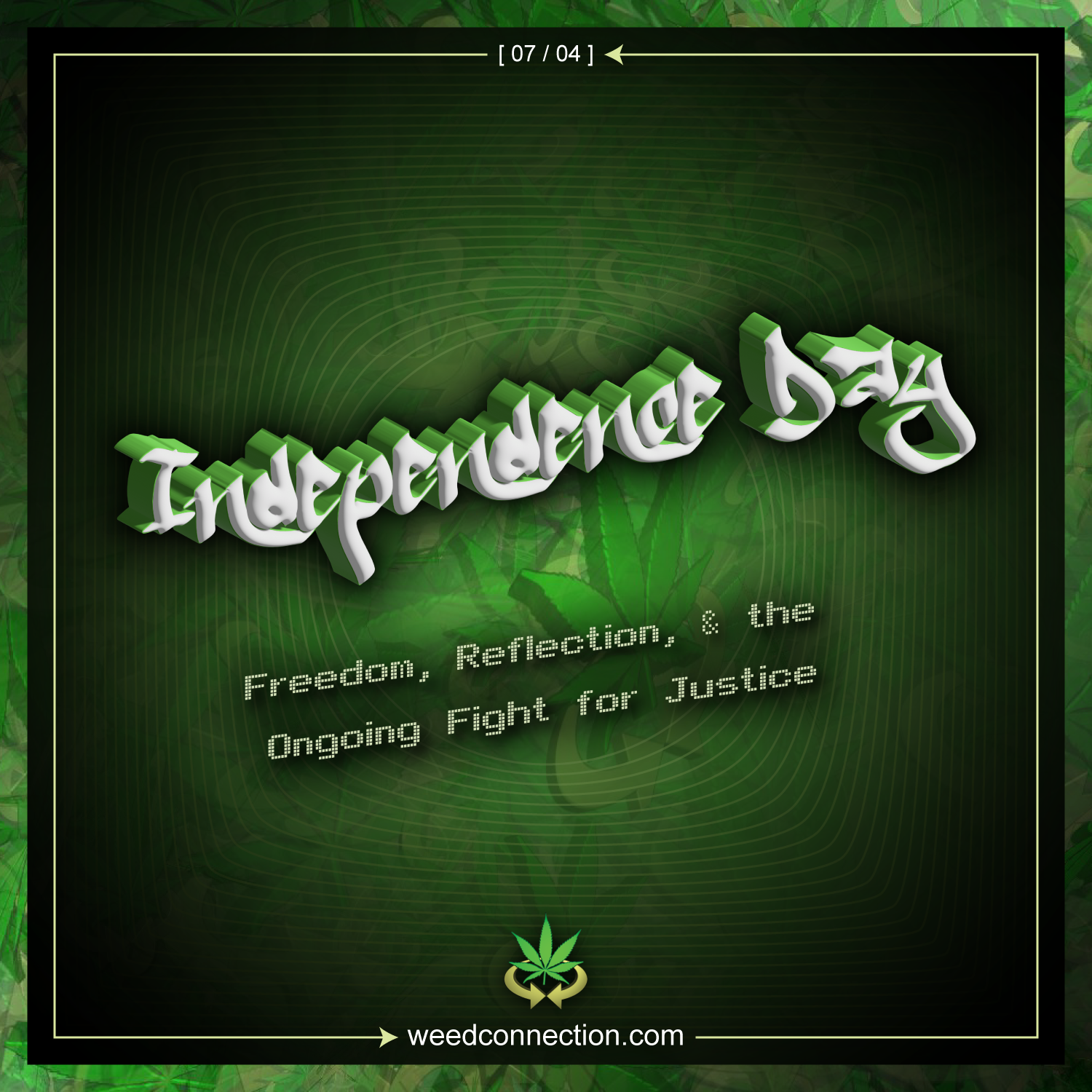
July 4th marks Independence Day — a celebration of the United States declaring freedom from colonial rule in 1776. It’s a day known for fireworks, cookouts, and red-white-and-blue everything — but it’s also a moment to pause, reflect, and ask: what does freedom truly mean today?
🗽 Freedom & Self-Determination – At its core, Independence Day honors the spirit of autonomy — the idea that people should have the power to govern their own lives.
📜 Courage to Break Away – The Founding Fathers made bold moves in the face of injustice. True patriotism means continuing that fight — especially when systems fail the people they were meant to protect.
🤝 Unity in Progress – July 4th isn’t just about where we came from — it’s about where we’re going. Freedom is not fully realized until it’s shared equally and equitably by all.
🔥 Host with Purpose – Bring people together for a BBQ, beach day, or bonfire — and create space for meaningful conversations, music, and gratitude.
🧠 Reflect & Educate – Learn about the perspectives often left out of history books: Indigenous sovereignty, Black liberation, immigrant stories, and ongoing fights for civil rights.
📣 Support Local & Marginalized Communities – True freedom means economic empowerment too. Buy from Black-owned, Indigenous-owned, and small businesses making a difference.
🎆 Honor with Action – Celebrate your freedom by defending someone else’s. Vote. Speak up. Show up. Share truth.
The cannabis plant has long been part of the conversation around personal liberty. Once criminalized and used to oppress communities, it’s now at the heart of a growing movement for freedom, wellness, and reparative justice.
On this Independence Day, honor the freedoms we enjoy by fighting for the ones we still need — including:
Celebrate freedom, but don’t forget who’s still fighting for it.
Popular Hashtags:
#IndependenceDay #FourthOfJuly #FreedomForAll #CannabisJustice #EquityInAction #LibertyAndJustice #PlantYourFreedom #CelebrateWithPurpose


Oklahoma City, OK: Adults who acknowledge having used cannabis within the past 30 days do not possess a significantly elevated risk of heart attack as compared to non-users, according to data published in the American Journal of Preventive Medicine (AJPM) Focus.
A pair of researchers affiliated with the University of Oklahoma Hudson College of Public Health assessed the relationship between marijuana use and asthma, depression, and myocardial infarction in a representative sample of 729,240 individuals.
Unadjusted models determined that current marijuana consumers possessed a decreased risk of heart attack and an increased risk of asthma; however, these associations became non-significant once investigators adjusted for covariates (e.g., age, pre-existing health conditions, etc.).
These findings “seem to support previous studies showing that marijuana use was not associated with MI [myocardial infarction],” the study’s authors concluded.
Researchers did identify a statistically significant link between current cannabis use and depression, but they cautioned that this result “does not indicate a causal association.”
Although individual studies assessing cannabis use and cardiovascular health have yielded inconsistent results, a literature review of 67 papers published in The American Journal of Medicine concluded, “[M]arijuana itself does not appear to be independently associated with excessive cardiovascular risk factors.”
Full text of the study, “The association between marijuana use and myocardial infarction, asthma, and depression in racial and sexual minorities: BRFSS 2016-2022,” appears in AJPM Focus.
San Diego, CA: Over one-third of California adults acknowledge having consumed cannabis within the past three months, and most say that they obtain it primarily from state-licensed dispensaries, according to survey data published in the journal Cannabis and Cannabinoid Research.
Researchers with the University of California at San Diego surveyed over 5,000 California adults. Respondents were demographically matched to the 2020 California census.
Thirty-seven percent of respondents reported currently consuming cannabis products, while 33 percent said that they were former consumers. Over three quarter of current consumers said that they obtained marijuana products primarily from licensed dispensaries – a finding that the study’s authors acknowledged is “in contrast to public reporting regarding the strong presence of the illicit marketplace” in California.
Current consumers said that their cannabis use positively impacted their lives, with participants reporting improved emotional (82 percent), mental (81 percent), and physical (62 percent) health. More than half of consumers acknowledged using cannabis in place of a prescription medication – a finding that is consistent with other surveys.
California voters approved a ballot measure regulating the adult-use marijuana market in 2016.
Full text of the study, “Cannabis use in California following legalization of recreational use,” appears in Cannabis and Cannabinoid Research.
San Diego, CA: The adjunctive use of CBD in the form of the plant-derived FDA-approved drug Epidiolex is associated with symptomatic improvements in autistic boys with severe behavioral problems, according to clinical trial data published in the Journal of Autism and Developmental Disorders.
Investigators affiliated with the University of California at San Diego assessed CBD treatment versus placebo in a cohort of 39 autistic boys ages 7 to 14. Clinicians observed participants on either a weekly or biweekly basis throughout the study period but were unaware of which participants were consuming CBD or placebo until after the study’s conclusion.
“Blinded clinical impressions showed almost two-third of the participants had behavioral improvements with CBD,” researchers reported. “Reductions in aggressive behaviors and hyperactivity were observed most frequently, with improvements in communication being seen in almost 30 percent. Since many of the participants were non-speaking at the onset of the study, this was a notable change, with several of the children beginning to use words for the first time.”
Investigators did not identify significant differences between CBD treatment and placebo on other outcome measures – a result that they attributed to the study’s small sample size and a greater than expected placebo effect. They acknowledged that Epidiolex possesses an acceptable safety profile and is well-tolerated in this patient population. (Epidiolex was approved by the FDA in 2018 specifically for the treatment of Dravet Syndrome and Lennox-Gastaut Syndrome, two rare forms of childhood epilepsy.)
“Despite the limitations, this study provides valuable new information about a potential role of CBD in improving behavior in a subset of children with autism, as well as the strong role the placebo effect plays in this condition,” the study’s authors concluded.
Several other placebo-controlled trials and observational studies have shown that the use of cannabinoids can improve symptoms and provide quality-of-life benefits to patients with autism.
Full text of the study, “Cannabidiol treatment for severe problem behaviors in autistic boys: A randomized clinical trial,” appears in the Journal of Autism and Developmental Disorders.
Case Report: Topical Application of Hemp Seed Oil Mitigates Eczema Symptoms
Katowice, Poland: The daily application of hemp seed oil is associated with reduced inflammation, itching, and other symptoms associated with eczema, according to the results of a case study published in the journal Current Issues in Pharmacy and Medical Sciences.
Polish researchers reported on an eczema patient’s progress after using cannabis seed oil topically for three months. The patient applied the oil once daily prior to going to sleep.
“In our observational study, regular, 3-month application of the emulsion based on cannabis sativa L. oil considerably reduced inflammation, erythema, pruritus, xerosis and scaling of the skin, soothing excoriations and lichenification (hardening of the skin),” the study’s authors concluded.
A prior observational study similarly reported that the topical application of the plant-derived cannabinoids CBD and CBG (cannabigerol) reduced itching and other related symptoms in eczema patients.
Topical application of cannabinoids, particularly CBD, has demonstrated benefits in the treatment of a variety of skin-related conditions, including, leg ulcers, skin ulcers of the fingertips, psoriasis, erythema, pruritus, and acne. It has also been associated with wound healing in patients with refractory leg ulcers and with the rare skin blistering disease epidermolysis bullosa. The application of hemp seed oil has been shown to accelerate wound healing in animal models.
Full text of the study, “Topical use of cannabis sativa L.-based emulsion for management of atopic dermatitis persisting from infancy in a 23-year-old male – a case study,” appears in Current Issues in Pharmacy and Medical Sciences.